Let's cut right to the chase: there's no official OnlyFans map built into the platform. It's a concept—a tool fans wish they had—that would let you discover creators based on their geographic location, kind of like finding a coffee shop on Google Maps. While the feature doesn't actually exist, the fact that people are constantly searching for it tells us one thing loud and clear: fans want to connect with and support local talent.
Understanding the OnlyFans Map Concept
The whole idea behind an "OnlyFans map" is pretty simple but powerful. You'd pull up a map, see pins showing creators in your city or even your neighborhood, and find someone new to follow. The appeal comes from a basic human desire to feel a local connection. Supporting a creator who lives a few miles away just feels more personal and real than subscribing to someone on the other side of the planet.
It taps into the same mindset that makes us want to shop at a local bookstore or farmers' market. We like feeling like we're part of a community, and bringing that vibe to the creator world is a natural next step. But there's one massive reason the platform has deliberately steered clear of this: creator safety.
Why an Official Map Doesn't Exist
Putting a public-facing map out there would be a massive privacy and security nightmare for creators. It could easily expose their general—or worse, specific—locations to absolutely anyone, opening the door for stalking, harassment, and even real-world danger. OnlyFans has a responsibility to protect its users, and a feature that puts a pin on their location is a direct threat to that core mission.
The lack of an official map isn't an oversight; it's a deliberate safety measure. The platform is designed to protect creator privacy, which makes a searchable, public map a complete non-starter from a security perspective.
Since OnlyFans won't build it, this demand has opened the door for third-party tools and workarounds. Some are legitimate, privacy-first directories where creators have chosen to share a general location. Others, however, are shady and downright dangerous. Knowing the difference is crucial if you want to find local creators without putting anyone at risk. You can get a much deeper dive on this in our guide to the OnlyFans finder map.
In this guide, we're going to break down everything you need to know:
- The serious privacy risks involved for both creators and fans.
- Safe, ethical methods for discovering creators in your area.
- How to use privacy-first alternatives like Fanclan to connect with talent.
- Why creator consent is the most important factor in this discussion.
The Serious Privacy Risks of Mapping Creators
Let's be clear: the idea of a literal "OnlyFans map" is terrifying. Imagine your home or work address getting pinned on a public map for the entire world to see. That’s the exact danger these tools introduce, turning a digital space into a potential source of real-world harm.
For creators, the fallout would be catastrophic. A map would completely demolish the layer of anonymity that allows them to produce content safely and on their own terms. Exposing even a vague location opens the door to stalking, harassment, and other unwanted attention.
In the worst-case scenarios, it could escalate to doxxing—where private information is maliciously blasted across the internet—or even lead to physical danger. This isn't just a small risk; it's the core reason why an official map feature will never, and should never, exist.
It’s Not Just Creators at Risk—Fans Are Too
While creators are on the front line, fans who use these shady, third-party map tools are also walking into a minefield. These unofficial apps and websites are almost always built with bad intentions, operating far outside the safety of legitimate platforms.
When you engage with one of these tools, you're often prompted to give up personal data or grant invasive permissions. That information can easily be weaponized against you.
- Your Data Is the Product: Your own location, device details, and personal info can be scraped, collected, and sold to the highest bidder.
- Malware & Scams: These sites are notorious hotspots for malware, phishing attempts, and scams designed to drain your bank account.
- Totally Unreliable Info: The data on these maps is usually scraped, outdated, and completely unverified. You're not getting any real value, just a ton of risk.
A creator's decision to share their location must always be 100% voluntary and controlled by them. Unofficial map tools trample all over this basic principle of consent, treating sensitive info like it's public property and putting the whole community in jeopardy.
At the end of the day, using these dangerous tools undermines the very creators you want to support. Protecting your own digital security is just as crucial as respecting theirs. You can get a head start by checking out our essential tips on how to protect your privacy online.
Understanding these shared dangers is the first step. It makes it obvious why privacy-focused alternatives—which are built on creator consent and data protection—are the only real way forward for discovering and supporting talent safely.
How Global Creator Hotspots Drive Local Searches
The massive buzz around a hypothetical "OnlyFans map" isn't coming out of nowhere—it’s a direct response to how the platform has grown worldwide. Content creation isn't spread out evenly. Instead, we see huge clusters of creators and fans in certain countries, creating digital neighborhoods so dense that it’s only natural for users to start wondering, "So, who's creating content near me?"
It’s just like any other industry. Tech has Silicon Valley, and movies have Hollywood. When that much talent packs into one place, it becomes a hotspot. The creator economy works the same way. A few key countries have become massive hubs, which is exactly why so many people want a tool to discover local talent.
The United States as the Epicenter
The US is, without a doubt, the biggest market. This has created a unique situation where there are so many creators that finding one in your city or state feels totally possible. With that kind of density, the idea of a map-based search just makes sense.
The numbers don't lie. The United States is home to the largest number of creators, with around 1.1 million active profiles as of 2025. That's a huge slice of the platform's 4.1 to 4.6 million total creators. This incredible saturation is the main reason American users are the most vocal about wanting a map feature. You can discover more insights about these creator demographics on onlymonster.ai.
But it’s not just an American phenomenon. Several other countries have turned into major players, all adding to the global demand for better ways to find creators.
- United Kingdom: Right behind the US, the UK has a huge and very active creator community, making it another prime location where users are looking for local content.
- Brazil & Mexico: These two Latin American countries have seen explosive growth, quickly becoming major hubs for both creating and consuming content.
- Germany: As a powerhouse in the European market, Germany also has a strong and growing base of creators.
This clustering of creators is a double-edged sword. On one hand, it makes the idea of a local OnlyFans map incredibly appealing to people in these hotspots. On the other, it blows up the privacy challenge to a massive scale. Keeping over a million creators safe in just one country requires safety protocols that are airtight and non-negotiable.
Ultimately, where creators live directly shapes how users search. The more creators you have in one area, the more people will naturally want to find them. This link between global market trends and user behavior is precisely why the dream of a map-style tool is so persistent, especially in these major international hotspots.
Comparing Map Tools vs Directory Filters
When it comes to finding creators, the "how" is just as important as the "who." While the idea of a visual OnlyFans map might sound cool and straightforward, it’s a concept that lives in a dangerous gray area. On the flip side, you have directory filters—a much safer, consent-based approach.
Let’s break down the huge differences between these two methods, because understanding them is crucial for protecting yourself and the creators you want to support.
A hypothetical map tool would likely operate by scraping or guessing a creator’s location, almost always without them knowing or agreeing to it. This approach boils a creator’s identity down to a single, invasive data point: their physical location. It’s a method built on violating privacy from the ground up.
Directory filters are the complete opposite. They're built around creator consent. On platforms like Fanclan, creators choose to share general location details, like their state or country. This puts them squarely in the driver’s seat, letting them decide what they’re comfortable with while still making them discoverable to a local audience.
The Core Difference: Consent and Control
It all boils down to one thing: consent. One method strips control from creators, while the other hands it right back to them. An unauthorized map tool makes the dangerous assumption that a creator's location is public information—which it absolutely is not. This can lead to serious, real-world consequences, from online harassment to physical stalking.
Directory filters, however, work more like a digital business directory. A creator opts in, provides the info they want public, and can opt-out at any time. It's an ethical framework that builds a healthier, more respectful community for everyone involved.
The biggest flaw of any unofficial map tool is its total disregard for creator consent. A safe discovery process has to be built on trust and respect, where creators always have the final say on what personal information gets shared.
To really see the difference, let’s compare them side-by-side.
Location Discovery Methods Compared
Here’s a clear breakdown of how a risky, hypothetical map stacks up against a privacy-first directory.
| Feature | Hypothetical 'OnlyFans Map' | Third-Party Directory Filters (e.g., Fanclan) |
|---|---|---|
| Privacy | Extremely High Risk. Exposes creator locations without consent, leading to potential stalking and harassment. | Privacy-Focused. Creators voluntarily opt-in and control the level of location detail they share (e.g., country, not city). |
| Creator Consent | None. Data is typically scraped or inferred, violating personal boundaries and platform terms of service. | Consent-Based. Creators must actively choose to be listed, ensuring they are comfortable with being discovered by location. |
| Accuracy | Highly Unreliable. Information is often outdated, inaccurate, or completely fabricated, leading to a poor user experience. | Generally Accurate. Since creators provide the information themselves, the location data is far more reliable and up-to-date. |
| User Experience | Risky and Unethical. Using these tools supports privacy invasion and exposes users to potential malware and scams. | Safe and Ethical. Provides a secure way to find creators while respecting their boundaries and personal safety. |
The demand for location-based search is fueled by the global distribution of creators, as shown below.
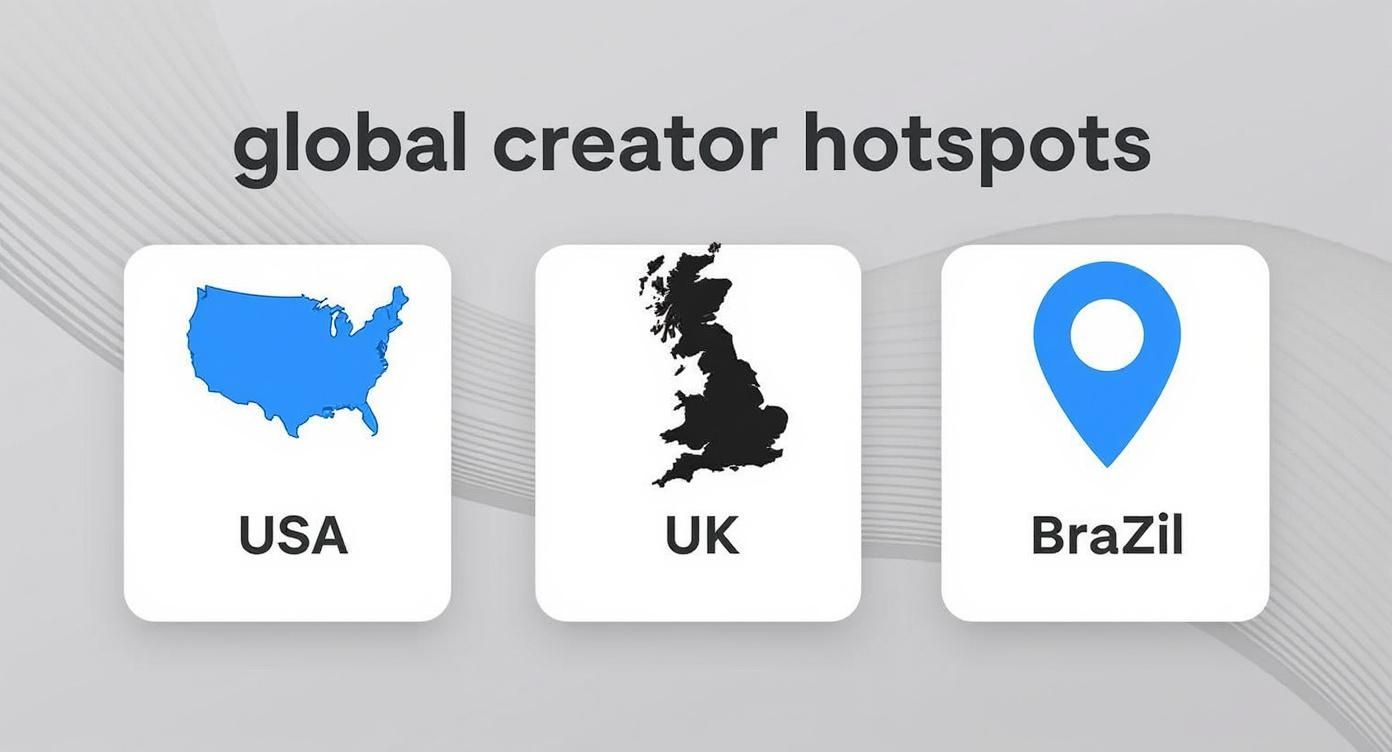
This data just goes to show why having safe, ethical search filters for hotspots like the USA and UK is more important than ever.
Making the Right Choice
At the end of the day, choosing directory filters over a shady map tool is about being a responsible fan. It’s about remembering that creators are people who deserve to feel safe.
Using tools that are built on consent means you can find amazing new talent without supporting a system that puts them at risk. To see how these ethical tools work in action, check out our guide on the 7 best OnlyFans finder tools for 2025, where we only feature safe and reputable platforms.
A Step-By-Step Guide to Finding Local Creators Safely
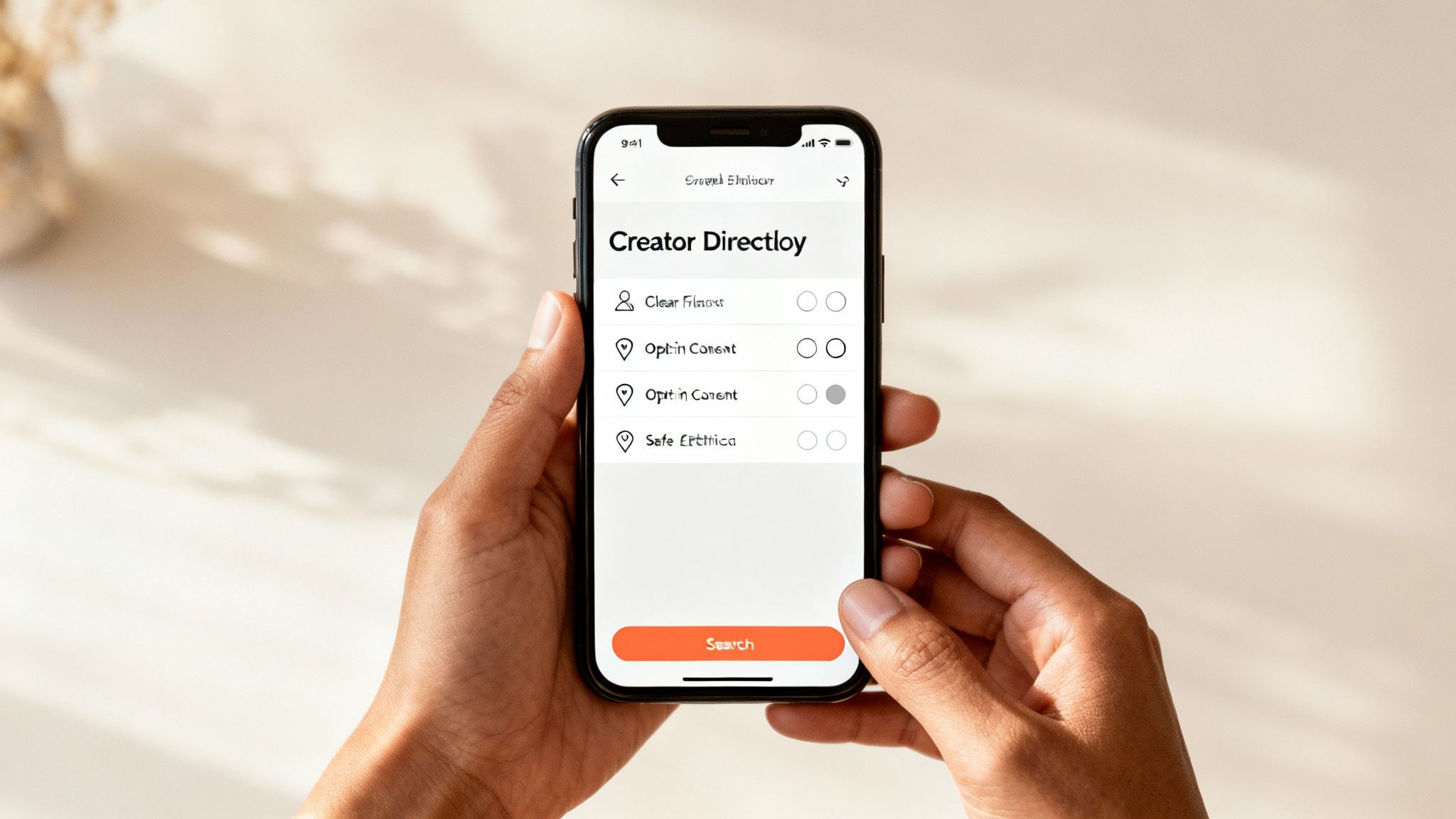
So, you're ready to find creators in your area but want to do it without creeping anyone out or compromising their safety? Perfect. You're in the right place.
Let's be clear: a literal OnlyFans map is off the table, and for good reason—privacy is paramount. But that doesn't mean you can't discover amazing local talent. The trick is to use methods built on consent, relying only on public information that creators have chosen to share.
This isn't about uncovering secrets. It’s about being a smart, respectful fan. We’ll walk through how to do it right, prioritizing digital safety and supporting the creator community in a responsible way.
Method 1: Use Privacy-First Directories
Your safest bet is starting with a third-party directory that puts creator consent front and center. Platforms like Fanclan are built on an opt-in system, allowing creators to voluntarily share a general location like their country or state.
You’re only seeing info that creators are 100% comfortable making public.
Here’s the game plan:
- Head to a Trusted Directory: Start on a platform known for its ethical approach.
- Use Location Filters: Look for the search filters and sort by country, state, or region.
- Browse the Results: Every creator you see has explicitly chosen to be discoverable in that area.
This approach works because it honors creator autonomy. And it's more effective than you might think. Given that the United States accounts for 32.13% of all OnlyFans users, the potential pool of local creators is massive. When creators in a huge market like that opt into a directory, it creates a rich, consent-based way for fans to find them. You can check out more stats on this over at pleazeme.com.
By sticking to consent-based platforms, you're doing more than just finding content—you're supporting a healthier, safer creator economy. It tells creators you value their safety as much as their work.
Method 2: Leverage Social Media Bios and Hashtags
Many creators use public social media platforms like Twitter and Instagram to promote their OnlyFans. It's common for them to drop location-based info in their bios or use local hashtags to connect with a nearby audience.
Think of it as another form of consent—they are willingly sharing this info to build their brand.
Here's how to turn your social feed into a discovery tool:
- Search Location-Specific Hashtags: Try searching tags like #PhillyCreator or #LondonOF. Be creative!
- Scan Public Bios: Keep an eye out for city or state names mentioned in creator profiles.
- Follow Creator Networks: Creators often shout out or collaborate with others in their area. Pay attention to who they follow and interact with.
This technique is all about using information that’s already public, which keeps the whole process ethical and safe for everyone. For a deeper dive, check out our full guide on how to find local OnlyFans creators, where we share even more practical tips.
At the end of the day, connecting with local creators is completely possible without resorting to dangerous, invasive tools. By focusing on directories built on consent and paying attention to public info, you can support talent in your area while championing the privacy and safety the entire community deserves.
Why Creator Consent Is the Foundation of a Healthy Community
Let's cut right to the chase. The whole conversation around a so-called OnlyFans map boils down to one simple, non-negotiable principle: consent. The creator economy isn't built on algorithms or code; it's built by real people sharing their personalities and their work. Invasive tools that track and expose someone's location without permission completely shatter the trust that holds this entire community together.
A platform that lasts is built on respect, not exploitation. When fans go looking for shady tools that violate a creator's privacy, they're actively harming the very ecosystem they claim to be a part of. Being a true supporter is about more than just a monthly subscription—it means protecting the people you follow.
The Real Cost of a Lack of Consent
Creators are entrepreneurs. They're artists, entertainers, and business owners who need a safe digital space to earn a living. Their safety isn't just a nice-to-have; it's a must-have. The platform's success is a direct result of their creativity and hard work.
The money involved is staggering. The platform recently pulled in $1.3 billion in revenue, and creator payouts hit an incredible $7.2 billion over just one year. A huge chunk of that economic activity comes from the US and Europe, which shows just how vital a stable, secure environment is for everyone involved. You can read the full report on these earnings on businessinsider.com.
When creators feel unsafe, the content suffers for everyone. A community that puts consent first ensures creators can keep doing what they do best without looking over their shoulder, and that benefits the entire platform.
A Call for Responsible Fandom
Every single fan has a part to play in keeping the digital space healthy. Pushing for privacy-first ways to discover creators isn't just about doing the right thing; it's a practical step to ensure the creator economy has a future.
This means consciously choosing safe alternatives over sketchy shortcuts. Instead of googling for invasive map tools, fans should be using and promoting directories where creators have chosen to be listed. This one change sends a clear message: the community values safety and respect above all else.
You can check out some great, ethical options in our guide to the 7 best adult entertainment directory platforms of 2025. Every platform on that list is built on the idea of creator control.
By acting like responsible digital citizens, fans help build a stronger, more respectful community where creators can thrive without risking their personal safety.
Ready to discover creators the right way? At Fanclan, we're committed to a safe, consent-based search experience. Our directory empowers you to find your favorite models through ethical, privacy-focused filters. Explore thousands of profiles and support a healthier creator community today at https://fanclan.io.