

An OnlyFans face search is exactly what it sounds like: a way to find a creator's profile by uploading a picture of them. Since you can't just drop an image into the search bar on OnlyFans itself, these third-party tools use facial recognition AI to do the heavy lifting, scouring the web to find a match.
The Growing Demand for Better Creator Discovery
As OnlyFans absolutely exploded in popularity, its own search function stayed surprisingly basic. You can really only search for someone if you already know their exact username or display name. This created a huge disconnect between what users wanted—to find new and specific creators—and what the platform actually let them do.
This gap was basically a gold rush for independent developers. They stepped in to build the tools everyone was asking for, leading to a boom in third-party search engines designed to make finding creators way easier. These sites offered things like keyword searches, location filters, and other handy features that OnlyFans just didn't have. You can check out some of the most popular options in our guide to the 12 best OnlyFans search engine platforms for 2025.
The Rise of Facial Recognition
Out of all these new discovery tools, the OnlyFans face search quickly became one of the most powerful—and controversial. Instead of using text, these services use AI and facial recognition to link a photo directly to a profile. It solved a very specific problem: finding someone when a picture is all you have. But that convenience came at a huge cost, creating a direct clash with privacy and ethics for the performers on the platform.
The platform's incredible growth is what really poured fuel on this fire. Between 2019 and 2023, the number of fan accounts rocketed from around 13.48 million to over 305 million. That's an insane increase of more than 2,000%. With creator applications hitting nearly 180,000 in a single month in early 2025, the sheer volume of people on the platform made finding anyone manually next to impossible. You can see more on the platform's wild growth with these OnlyFans statistics.
This massive growth created a huge problem: while there were more creators than ever, it was getting harder and harder to actually find them. The table below shows just how big the gap between platform scale and native search features became.
Platform Growth vs. Native Search Capabilities
| Metric | Statistic | Implication for Search |
|---|---|---|
| Fan Account Growth (2019-2023) | +2,000% (13M to 305M) | Basic username search is completely inadequate for a user base of this size. |
| Peak Creator Applications (2025) | ~180,000 per month | The pool of creators is too vast to browse manually, demanding better discovery tools. |
| OnlyFans Native Search | Username/Display Name Only | Users can't find creators based on content, location, or appearance without external help. |
Ultimately, the platform got too big for its own search bar. This is the environment where third-party search tools, including face search, found their footing.
This rapid expansion created a paradox: while more creators than ever were joining, finding them became harder. Facial recognition search offered a seemingly simple answer, but one that opened a Pandora's box of safety and consent issues that continues to define the conversation today.
How Facial Recognition Search Actually Works
So, how does an OnlyFans face search even work? It's not some kind of dark magic; it's just powerful data processing and pattern matching doing its thing. The easiest way to think about it is that your face is like a unique, biological barcode. Facial recognition tech is simply the scanner that reads that barcode, turning your distinct features into a string of numbers a computer can actually process.
The whole thing kicks off the second someone uploads a photo to one of these third-party search tools. The software doesn't "see" a face the way we do. Instead, it meticulously maps it out, identifying key landmarks known as nodal points. We're talking about the distance between your eyes, the exact width of your nose, the curve of your jawline, and the shape of your cheekbones.
Creating a Digital Faceprint
The AI measures all these points and how they relate to each other, creating a unique numerical code. This is called a biometric signature, or more simply, a "faceprint." This digital signature is what makes your face searchable in a database. It's a highly specific mathematical formula that is, in theory, completely unique to you.
Once the system has this faceprint, the real hunt begins. It takes that single signature and runs it against a massive database of other faceprints.
The search engine isn't looking for the exact same photo. It’s searching for other images that produce a statistically similar faceprint, running millions of comparisons in a matter of seconds.
This infographic gives you a good visual of how the huge demand for better search on the platform directly led to the rise of these AI-powered tools.
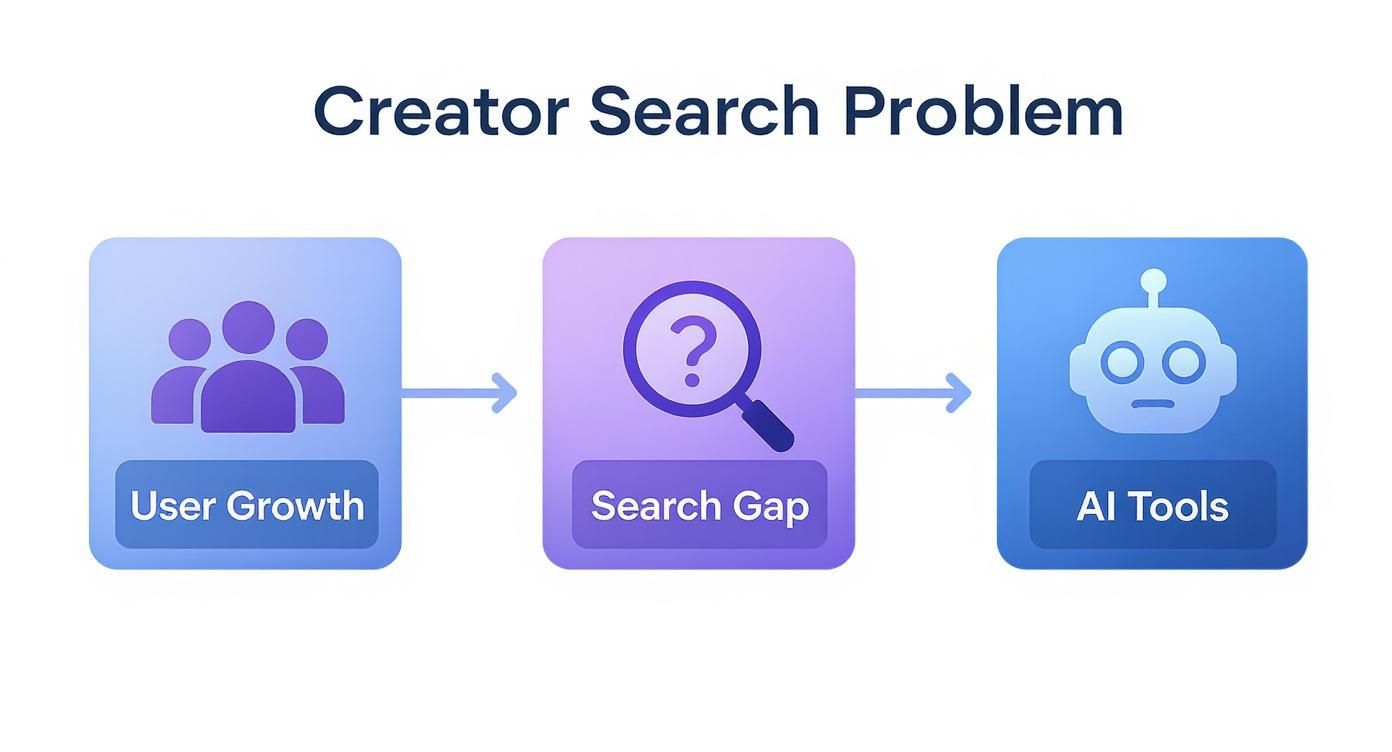
As you can see, the explosion in platform users created a huge search gap that specialized AI tools were more than happy to fill.
Matching Against Scraped Databases
It's crucial to understand that the databases these tools use have zero official connection to OnlyFans. They are built by scraping—basically, automatically downloading—any publicly available content from profiles. This includes profile pictures, banner images, and any other media that's visible to someone who isn't a subscriber.
From there, the system calculates a similarity score for every potential match it finds. This score is just a number representing how closely a faceprint in the database lines up with the one from the uploaded photo. A high score means a probable match, while a low score suggests it's likely a different person.
The tool then spits out the results, usually ranked from most to least likely. The entire process is a souped-up version of what's used in a reverse image search on OnlyFans, but it's hyper-focused on biometric facial data.
The Wild West of Third-Party Search Tools
Because OnlyFans’ own search function is so bare-bones, a whole market of third-party tools has popped up to fill the void. Think of them as specialized search engines built just for OnlyFans, but they aren't affiliated with the official site at all.
Some of these tools, like OnlyFinder, work like a typical search engine, letting you find creators using keywords, locations, or other filters. Others, like FaceCheck.ID, are all-in on facial recognition—their entire purpose is to take a photo you upload and match it against their massive library of creator profiles. This is the reality of the OnlyFans face search world.
Comparing The Key Players
The real power behind these tools is the sheer size of their databases. To stay competitive, these platforms have scraped and indexed millions of profiles, giving them a huge advantage in search accuracy. By 2025, tools like OnlyFinder, OnlySearch, and FaceCheck.ID have each indexed between 1 million to over 4.7 million OnlyFans profiles.
That massive scale is exactly what makes them so effective. They offer detailed filters for gender, age, and location, and some even let you upload a photo for a face match.
The bottom line is simple: these tools offer a powerful search experience that OnlyFans itself doesn't provide. They turn a frustrating, manual hunt into a quick, automated process.
To give you a clearer picture, here’s a quick rundown of what’s out there.
Comparing Popular OnlyFans Search Tools
The market for third-party OnlyFans search tools is pretty diverse. Some are great for general discovery, while others are built for the specific purpose of facial recognition. Here's a look at how some of the popular options stack up against each other.
| Tool Name | Indexed Profiles | Key Features | Best For |
|---|---|---|---|
| OnlyFinder | 4.7M+ | Keyword search, location filters, categories | General creator discovery and browsing by niche. |
| OnlySearch | 3.5M+ | Advanced filters, name search, location | Finding specific creators when you have some info. |
| FansMetrics | 2M+ | Performance analytics, trend tracking | Market research and analyzing creator popularity. |
| FaceCheck.ID | 1M+ | Facial recognition, photo matching | OnlyFans face search using an uploaded image. |
As you can see, there’s a trade-off. A tool with a giant database might be great for broad searches, but another might have more precise filters or a specific function like facial recognition that better suits your needs.
Their payment models are also all over the place, which affects how you can use them.
- Free Tools: Many offer basic search functions for free, usually paid for by ads on the site. They’re easy to access, but you might hit a limit on how many searches you can do or how detailed the results are.
- Freemium Tools: This is a common model. You get a few free searches to try it out, but the best features—like unlimited searches, higher-accuracy matching, or more data—are kept behind a monthly subscription.
Ultimately, this collection of third-party services gives users way more options than OnlyFans ever could. They've completely changed the game for discovering creators. If you want to explore some of the more responsible and privacy-friendly options, check out our guide on the 7 best OnlyFans accounts discovery tools in 2025.
The Dark Side of Creator Discovery

While third-party search tools seem like a handy solution for finding new creators, they hide a much darker reality, especially when facial recognition gets involved. An OnlyFans face search is more than a simple discovery tool; it's a powerful weapon that can demolish the anonymity countless creators depend on for their safety.
The technology itself exists in a murky ethical gray zone, and the central problem is consent. Or rather, the complete lack of it. Creators share content on OnlyFans expecting it to stay within that walled garden, seen only by their subscribers. They never agree to have their faces scraped, indexed, and thrown into a public database that anyone can use to identify them.
These tools effectively turn a creator's face into a public key, unlocking their private persona without their permission. This breach of trust transforms a tool of convenience into one of potential surveillance and harassment.
This non-consensual identification creates immediate, real-world risks, turning digital content into a direct threat against a creator's personal life.
The Real-World Dangers for Creators
The most direct threat is doxxing—the malicious act of publishing someone's private information online. A quick face search can instantly link a creator's anonymous online presence to their real-world identity. Suddenly, their legal name, home address, day job, and even family details are out in the open.
Once that line is crossed, a flood of other dangers follows:
- Harassment and Stalking: With a real name and location, creators become easy targets for obsessive followers, online bullies, and even in-person stalkers.
- Professional Repercussions: Many creators keep their OnlyFans work separate from their professional lives. Getting outed can mean getting fired, facing discrimination, and suffering irreparable damage to their careers.
- Personal and Familial Conflict: The discovery of an OnlyFans account can strain or completely shatter relationships with family and friends who were never meant to know.
AI-driven tools have made this threat more accessible than ever before. As of 2025, search engines like JuicySearch and FaceCheck.ID are using their own AI to scan millions of OnlyFans profiles, matching faces from a single uploaded photo. These tools aren't affiliated with OnlyFans, but they've exploded in popularity for this exact, invasive purpose. You can learn more about these AI-powered OnlyFans search tools on tuneboto.com.
The Psychological Toll and Murky Legality
Beyond the physical threats, the constant fear of being exposed takes a massive psychological toll. Creators are stuck living with the anxiety that their privacy could be destroyed at any moment, leading to crippling stress, paranoia, and burnout.
What makes it worse is that the legal system hasn't caught up. These search tools often wiggle through legal loopholes, claiming they only scrape "publicly available" data. While doxxing and harassment are illegal, the act of building the database in the first place is much harder to prosecute.
This leaves creators feeling helpless, forcing them to take security into their own hands. If you're looking to lock down your digital life, our guide on how to protect personal information online with essential tips is a great place to start. This new reality highlights the ugly side of a technology that values discovery over the basic safety and consent of the very people it targets.
A Practical Safety Guide For Creators

With the very real risks of an OnlyFans face search, creators have to be smart and proactive about protecting their real-world identity. Sure, being a complete ghost online is next to impossible, but you can absolutely make it a whole lot harder for those facial recognition algorithms to get a clean lock on you.
Think of it like digital camouflage. The main goal is to mess with the AI's ability to create an accurate "faceprint." You do that by throwing in variables that confuse its pattern-matching game, giving you back a crucial measure of control over your digital life.
Control Your Content and Environment
Your first line of defense is simply what you choose to show on camera. A few intentional, simple choices during your shoots can make a night-and-day difference in how easily a face search tool can identify you.
Start with your surroundings. Always try to shoot against a plain, neutral background that gives away nothing personal. Be on the lookout for things like neighborhood landmarks, unique furniture, personal photos, or even a piece of mail sitting on a table. All those little details can be pieced together to pinpoint your location.
Don't forget about permanent features on your body, either. Distinctive tattoos and birthmarks are just as unique as a fingerprint and can be used to identify you, even if your face is hidden. You can use makeup, clothing, or just clever angles to cover them up when you're filming.
Think of your content as your digital territory. When you carefully manage every single element in the frame—from the background to your body—you’re setting up essential boundaries that shield your real-world identity.
Disrupting Facial Recognition AI
Beyond just controlling the setting, you can take active steps to throw the AI itself off your trail. Facial recognition software needs consistency to map out your features. The more you can switch up your appearance, the better your chances are.
Here are a few practical tricks to make your face a tougher read for any algorithm:
- Strategic Angles and Lighting: Direct, brightly lit, face-on shots are a dream for AI scanners, so avoid them. Instead, play with dramatic side lighting (think chiaroscuro), shoot from high or low angles, and use shadows to obscure key points like the bridge of your nose or your eyes.
- Makeup and Accessories: Don't be afraid to go bold. Heavy, artistic, or asymmetrical makeup can seriously alter how an AI sees your facial structure. The same goes for large glasses, hats with brims that cast shadows, or even a strand of hair that breaks up the patterns the software is hunting for.
Strengthen Your Digital Hygiene
Your safety plan has to go way beyond what’s visible on camera. Having strong digital hygiene is absolutely critical for keeping your professional persona separate from your personal life. A big one: never, ever reuse profile pictures from your personal social media on any of your creator accounts.
It's also a smart move to use a pseudonym and create totally separate email addresses for your creator brand. This simple step helps prevent your real name from ever being linked to your work. For an even deeper dive into securing your info, check out our guide on how to avoid online scams and protect your data. By building these layers of protection, you make it incredibly difficult for anyone to connect the dots.
Finding and Supporting Creators the Right Way
Now that we’ve pulled back the curtain on the sketchy world of Onlyfans face search tools, it’s obvious we need a better way to find creators. The good news is, there are tons of ethical methods to discover new talent that actually support the community instead of undermining it.
The best approach is always to use channels where creators have total control over their own visibility. Ditch the invasive, non-consensual tools and instead turn to platforms and communities where performers choose to share their work. It's a simple switch that protects creators and makes the entire space safer and more respectful for everyone.
Stick to Creator-First Platforms
The most ethical and straightforward alternative is using a discovery platform built for creators to opt-in. This is exactly why services like Fanclan exist. We're not a shady, third-party scraper; we're a directory that creators join because they want to be found.
Every single profile you see on a platform like ours is there by choice. This model puts the power squarely back in the hands of the creators, letting them manage their own discovery while giving fans a trusted way to find awesome new content.
When you choose a platform where creators give their explicit consent to be listed, you're doing more than just finding a new favorite account. You're actively voting for a safer, more ethical ecosystem where performers can grow their audience without risking their privacy.
Let the Community Be Your Guide
Another fantastic way to find new creators is to tap into the communities where they’re already promoting themselves. Social media is buzzing with this kind of consensual discovery if you know where to look.
Check Out Creator Shout-Outs: The creators you already love and follow are your best resource. Performers often collaborate with or give shout-outs to others in their network, which is a great way to find vetted talent.
Dive into Subreddits and Hashtags: Communities on Reddit (think niche subreddits) and dedicated hashtags on platforms like Twitter are goldmines. They're packed with creators promoting their own pages and connecting directly with fans who are looking for them.
At the end of the day, it’s all about finding incredible content without putting anyone's safety on the line. By using these approved, creator-friendly channels, you can support the performers you admire and help build a community founded on respect and consent.
Burning Questions Answered
When you start digging into the world of an OnlyFans face search, a lot of questions pop up. It’s a murky topic, so let’s clear the air on some of the biggest concerns about how these tools work and what they mean for creators.
Is It Actually Illegal to Use an OnlyFans Face Search Tool?
This is where things get sticky. The tools themselves often operate in a legal gray area, scraping images that are technically public. But here's the critical part: how you use that information is what really matters.
Using a face search to find someone's private info to harass, stalk, or doxx them is absolutely against the law in most places. The laws are still playing catch-up with the tech, but using these tools for malicious purposes is a fast track to serious legal trouble.
How Good Are These Face Search Tools, Really?
They can be surprisingly good... and also completely wrong. The accuracy is all over the place. The best tools give you a "similarity score" to show how confident they are in a match, but they're far from perfect.
Results can get thrown off by all kinds of things:
- Blurry or low-quality photos
- Weird lighting, shadows, or odd camera angles
- Heavy makeup, glasses, or anything that changes the face's appearance
So, while they can sometimes find a needle in a haystack, they also create false alarms or miss obvious matches entirely. They're powerful, but don't trust them to be 100% right.
Can Creators Actually Stop People From Scanning Their Photos?
Blocking your images from being scanned completely is next to impossible once they're online. It's like trying to stop the rain.
But creators aren't helpless. They can take smart steps to make it much harder for these tools to get a lock. This means using strict privacy settings, being clever about obscuring parts of the face, and never, ever recycling the same photos across public social media and their OnlyFans page. Some creators also fight back with DMCA takedown notices, but that can feel like a never-ending game of whack-a-mole.
Want to discover amazing creators the right way? Fanclan is built on a foundation of consent and respect. It's a place where performers want to be found. Use our powerful filters to explore thousands of profiles without ever crossing a line. Find your next favorite creator on Fanclan.io.