



At its core, subscription model pricing is simple: customers pay a recurring fee, usually monthly or yearly, to get consistent access to a product or service. This isn't just a payment plan; it's a complete shift from one-off sales to building long-term relationships that create predictable, stable income. It’s the engine powering everything from your Netflix binge to your favorite creator’s Patreon.
Why Subscription Pricing Is Reshaping Business
The business world has quietly gone through a massive transformation. Not too long ago, the holy grail was the big, one-time sale—a software license, a new car, a music album. Now, the game has changed from ownership to access. Just think about how we went from buying CDs to streaming endless music on Spotify. That’s the subscription economy in a nutshell.
This isn’t just some passing trend. It's a fundamental rewiring of how businesses deliver and capture value. For any company, and especially for content creators, getting a handle on subscription model pricing is no longer just a good idea. It’s a key strategy for predictable growth, building die-hard fan loyalty, and creating a business that can handle the inevitable ups and downs of the market. That steady, recurring revenue makes it easier to plan for the future and reinvest in making your content even better.
From One-Time Sales to Ongoing Relationships
The real magic of the subscription model is how it aligns your success with your customers' happiness. Instead of a quick transaction and a goodbye, the relationship becomes a continuous journey where you consistently deliver value.
The global subscription economy is on track to hit $1.5 trillion by 2025. This isn't just a niche market; it's a clear signal that both consumers and businesses are all-in on access over ownership. That explosive growth shows just how crucial it is to embrace recurring revenue.
The infographic below breaks down the key differences between the old way of doing things and the subscription-based model.
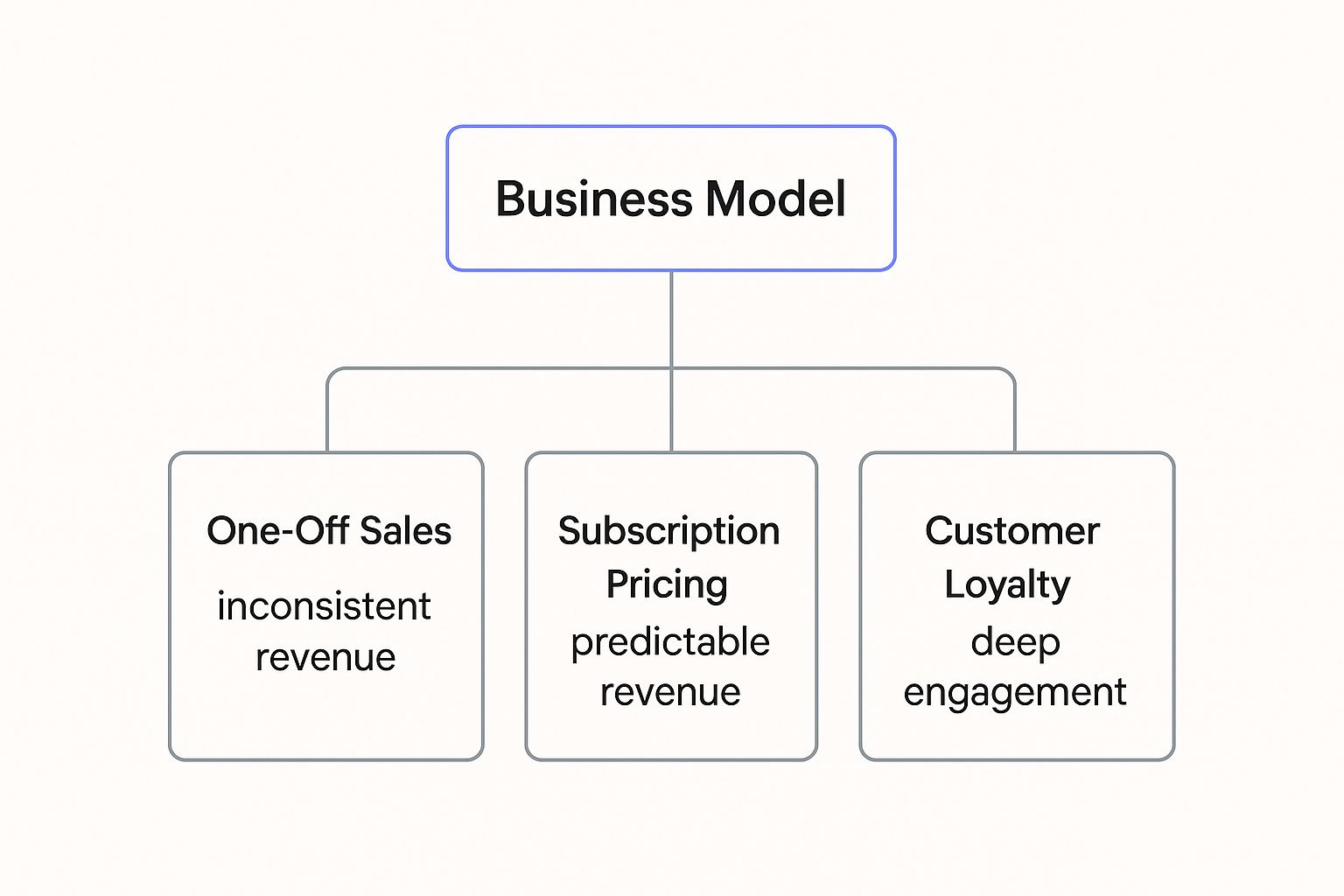
As you can see, switching to a subscription model turns unpredictable sales into a steady, reliable revenue stream, which in turn lets you build deeper connections with your audience. The results have been incredible, with the market growing by an insane 435% in just a decade. If you want to learn more, you can discover more about the scale of this economic shift and what it means for modern businesses. Getting a grip on these dynamics is the first step toward building a pricing strategy that actually works.
Finding Your Perfect Pricing Model
Picking the right subscription pricing strategy is a bit like choosing the right tool for a job. You wouldn't try to hammer in a screw, right? In the same way, the model that works wonders for a giant like Netflix probably isn't the best fit for a solo content creator or a small software startup.
Let's break down the most common models out there. We'll use some simple, real-world analogies to figure out which one really clicks with your goals.
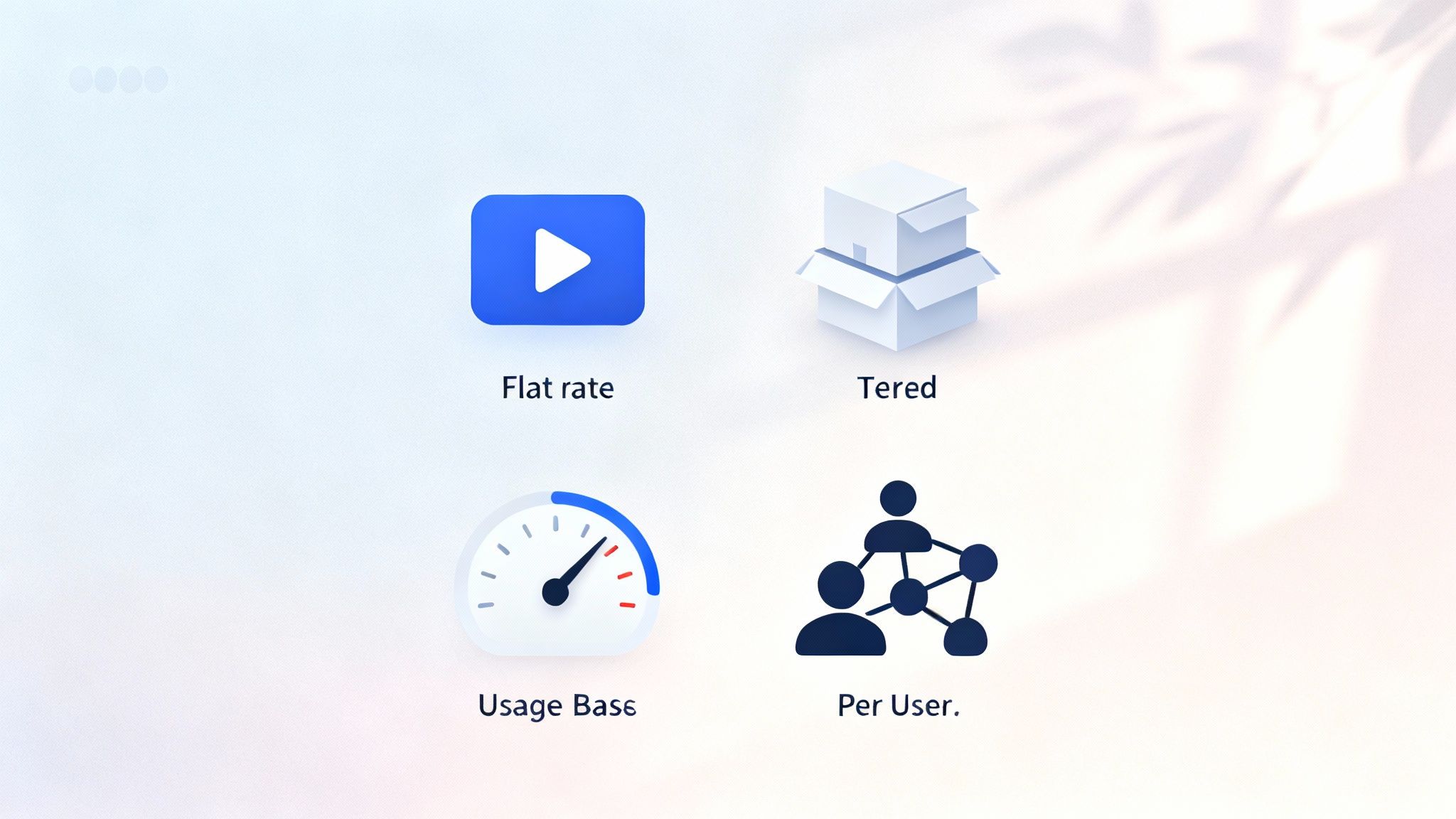
Flat-Rate Pricing: One Price Fits All
Think about your Spotify or Netflix account. You pay one simple, fixed price every month, and boom—you get access to everything. That's flat-rate pricing in a nutshell.
It’s beautifully simple for everyone involved. Customers know exactly what they’re paying, and businesses get predictable revenue. The value is super clear: pay this, get all of that. This model is a killer choice when you have a single, strong product that most users will get similar value from. A creator, for example, might offer an all-access pass to their entire content library for one monthly fee.
But its greatest strength is also its biggest weakness. A power user who's glued to your content 24/7 pays the exact same as someone who logs in once a month. You could be leaving money on the table from your most dedicated fans.
Tiered Pricing: The Good, Better, Best Approach
Tiered pricing is like buying a car. You can stick with the basic model, or you can add packages for premium features like a killer sound system or heated seats. Each tier unlocks more value for a slightly higher price.
This is easily one of the most popular subscription models because it lets you cater to different types of customers. A new startup might only need the basic features of a project management tool, while a huge corporation needs all the bells and whistles, like advanced security and analytics. Tiers let you serve both without scaring either away.
Creators use this model all the time. A basic tier might grant access to a private blog, while higher tiers could include exclusive videos, one-on-one chats, or even personalized content. Many even use a free tier to build a massive audience, which is a powerful marketing move. You can see exactly how that works in our guide on how a free OnlyFans works for both creators and their fans.
The real secret to making tiered pricing work is to build each tier around a specific type of fan or customer. You have to know what different segments of your audience truly value and design your packages to meet those needs perfectly.
Usage-Based Pricing: Pay for What You Use
This one feels a lot like your electricity bill or your mobile data plan. The more you use, the more you pay. Usage-based pricing links the cost directly to how much of the service someone actually consumes.
It’s an incredibly fair and transparent approach since customers only pay for the value they actually get. This makes it perfect for services where usage can swing wildly from one person to the next, like cloud storage platforms (Dropbox comes to mind) or services that charge per text message sent.
The downside? Revenue can be a rollercoaster, making it hard to predict. Plus, some customers get anxious when they don't know exactly what their bill will be each month.
Per-User Pricing: Scaling with Your Team
Finally, we have per-user pricing. You see this everywhere with team collaboration software like Slack or Asana. The idea is dead simple: you pay a set price for each person on your team who needs access.
This model is easy for customers to grasp, and it allows your revenue to grow as your customer's company grows. They hire more people, you make more money. The biggest risk here is "seat sharing," where multiple people use a single login to cut costs, which can cheapen your service.
Comparing Core Subscription Pricing Models
To make it even clearer, here’s a quick side-by-side look at how these models stack up. Think of this as your cheat sheet for picking the right strategy.
| Model Type | Best For | Pros | Cons |
|---|---|---|---|
| Flat-Rate | Simple products with a uniform user base (e.g., streaming services). | Simple to communicate; predictable revenue. | Can't capture value from high-use customers. |
| Tiered | Products with diverse customer segments (e.g., SaaS, creators). | Caters to multiple budgets; clear upsell path. | Can become complex; customers might choose the wrong tier. |
| Usage-Based | Services with variable consumption (e.g., cloud storage, APIs). | Fair and transparent; cost scales with value. | Unpredictable revenue; customers may fear high bills. |
| Per-User | Team-based software and collaborative tools (e.g., Slack, Asana). | Simple to understand; revenue scales with team size. | Can discourage adoption; encourages account sharing. |
Ultimately, there's no single "best" model. The right choice depends entirely on what you're offering, who you're selling to, and what your long-term goals are.
The Building Blocks of a Winning Price Strategy

Picking a pricing model is just the start. To really nail your subscription model pricing, you have to ditch the guesswork and let data guide your decisions. The goal is to land on that perfect price point—one that reflects the value you’re providing while keeping your business profitable for the long haul.
At its core, this comes down to a careful balancing act between two key numbers: Customer Lifetime Value (LTV) and Customer Acquisition Cost (CAC). LTV is the total amount of money you can expect from a single subscriber over time. CAC is what you spent to get them in the door. For a subscription business to thrive, your LTV needs to be way higher than your CAC. Simple as that.
Pinpoint Your Value Metric
The absolute most important piece of your pricing puzzle is the value metric. This isn't about your features; it's about the core benefit your fans are actually paying for. Your pricing should be anchored directly to this.
Let me break it down:
- For Netflix, the value metric is a bottomless pit of entertainment.
- For Dropbox, it’s how much secure storage you get.
- For a creator on OnlyFans or Fanvue, it could be the exclusive access, the personal connection, or that feeling of being part of an inner circle.
When you tie your price to your value metric, your revenue naturally grows as your fans get more of what they came for. This lines up your success perfectly with their happiness.
Analyze Competitors Without Starting a Price War
You absolutely need to know what other creators in your niche are charging. But let's be clear: this isn't about a race to the bottom. Slashing prices just to be the cheapest helps no one. Think of competitor pricing as a benchmark to understand the market and figure out where you fit in.
Ask yourself these questions:
- Is the value I'm offering better than theirs?
- Do I provide something unique that they don't?
- Is there a group of fans they're overlooking that I could connect with?
The point of checking out the competition isn't to copy their prices. It's to understand what fans in your market are willing to pay for. Use that knowledge to highlight what makes you different and justify a price that matches the awesome experience you provide.
In the end, your pricing strategy has to be tied to what your audience believes you're worth. Getting this right means you'll need to test and tweak things over time. Even small changes to your page can make a huge difference in how many people sign up. You can learn how to boost earnings with conversion rate optimization strategies that are all about turning curious visitors into loyal fans.
By keeping an eye on your LTV, locking down your value metric, and smartly positioning yourself against the competition, you can build a pricing structure that fuels growth for years to come.
How to Price for Today's Subscription Customer
Today’s subscribers are sharp. They're careful with their money and totally overwhelmed by the sheer number of services demanding a monthly fee. We've all felt it: "subscription fatigue." It’s that feeling of dread when you look at your bank statement and see a dozen recurring charges.
Because of this, people are incredibly wary of getting locked into long-term commitments they can't easily back out of. The old days of trapping customers with confusing, iron-clad contracts are over. To win today, you need a new playbook built on flexibility, transparency, and trust. It’s less about locking people in and more about making them want to stay.
Fight Subscription Fatigue with Flexible Options
The biggest hurdle is the customer's fear of making a bad financial decision. You have to lower that perceived risk right from the start. Give them clear, low-commitment options that put them firmly in control.
Think about it from their side. A rigid annual plan feels like a massive gamble. A weekly or even monthly option? That’s a much smaller, safer bet.
The numbers don't lie. Data shows a huge shift in how people pay for subscriptions. By 2025, weekly subscription plans are projected to become the main revenue source, pulling in 46% of all subscription money. Meanwhile, traditional monthly plans are expected to drop off a cliff.
This isn't just a random trend. It's a clear signal that subscribers want an easy out if they're not happy.
The Power of a Great Free Trial
Want to completely remove the barrier to entry? Offer a free trial. It's the ultimate "try before you buy" move, letting potential fans experience the full value of what you offer without spending a dime.
A well-executed free trial does more than just get people to sign up; it builds confidence in your content. In fact, offering a free trial can increase a customer's lifetime value (LTV) by as much as 64%. Check out more insights on subscription trends dominating 2025 to see just how powerful this is. When people know exactly what they're paying for, they're far more likely to stick around for the long haul.
Build Loyalty by Giving Customers Control
Real loyalty isn’t created by making it a nightmare for people to leave. It’s earned by consistently giving them reasons to stay. This is where flexible account management becomes your secret weapon for retention.
Instead of just having a giant "CANCEL" button, give your subscribers more control over their payments.
- Pause Subscription: Let users hit the pause button for a month or two. This is perfect for fans who are traveling or just need a short break. It keeps them in your world without forcing them to cancel completely.
- Downgrade to a Lower Tier: Is a fan feeling the pinch financially? Offer them a path to a cheaper plan. It’s way better than losing them forever and keeps the door open for them to upgrade again later.
- Easy Switching: Make it painless for users to move between different plans as their needs or budget change.
When subscribers feel like they have total control, they trust you more. For creators trying to build a reliable income stream, this is everything. To get a better handle on the mechanics behind this, take a look at our deep dive into how OnlyFans payment works for creators.
At the end of the day, smart subscription pricing isn't just a transaction. It's the foundation of a lasting relationship built on respect and clear value.
Subscription Pricing Strategies in the Real World

Theory is one thing, but seeing how these pricing models play out on the street is where the real learning happens. When you look at companies you use every day, you can start to see the genius behind their strategies. The lessons here are gold, whether you're a massive company or a single creator just starting out.
Take Adobe Creative Cloud—they are the undisputed masters of tiered pricing. They've expertly sliced their market into different groups: individuals, students, and businesses. Each tier unlocks more software and collaborative tools, making sure no one pays for more than they actually need. It’s how they manage to sell to everyone from a freelance photographer to a global ad agency.
This is the exact same playbook used in the creator economy. On a platform like Patreon, a creator might set up a basic tier for access to a private blog, a mid-tier for behind-the-scenes videos, and a top tier for personal video calls. The value proposition at each level is crystal clear, nudging fans to climb the ladder as they get more invested.
The Power of Simplicity and Hybrid Models
Then you have the complete opposite approach with Netflix, the king of flat-rate pricing. You pay one simple, predictable fee, and the entire library is yours. That's it. The beauty of this model is its sheer simplicity. No confusing tiers, no complicated add-ons—just a straightforward ticket to entertainment. It completely removes the headache from the decision to sign up.
And let's not forget the hybrid models, where Amazon Prime reigns supreme. Amazon brilliantly bundles a whole suite of perks under a single subscription. You might sign up for the fast shipping, but you stay for Prime Video, Prime Music, and all the exclusive deals. This creates an incredibly "sticky" service. Even if you don't use every single feature, the combined value feels so massive that canceling seems almost unthinkable.
The big takeaway from these giants is simple: winning at subscription pricing isn't about being the cheapest. It's about perfectly matching your price to the value you deliver, whether that's through different feature tiers, dead-simple access, or a bundle of perks that are too good to pass up.
Pricing in the Creator Economy
The creator economy runs on these very same ideas, just with a much more personal flavor. Platforms like OnlyFans and Fansly give creators the tools to build their own subscription empires from the ground up. Knowing the subtle differences between these platforms can make or break your success. To get a better handle on it, check out our deep dive into OnlyFans vs Fansly.
From a financial perspective, fans are all-in. The average monthly spend on subscriptions is projected to hit $133 by 2025, with many popular plans hovering around the $9.99 mark. In fact, the average price for a monthly sub has already jumped 14%, climbing from $7.05 to $8.01. This shows people are more than willing to pay for content and services they value. You can discover more trends in the subscription economy to see how these numbers are shaping the entire market.
Whether you're building a software giant or a tight-knit community of fans, these examples prove one thing: the right subscription pricing strategy isn't just a detail—it's the engine for your growth.
Common Subscription Pricing Questions Answered
Diving into subscription pricing can feel a bit overwhelming at first. Even after you nail down the basics, the real-world questions start popping up fast. Think of this as your quick-reference guide for those tricky spots every creator hits.
Let's clear the air on these common hurdles so you can build your subscription business with confidence.
What Is the Best Subscription Model for a New Business?
For most new creators or businesses, the tiered model is your best friend. It’s the classic "small, medium, large" approach, letting you cater to different fans with different budgets right out of the gate. This naturally creates an upgrade path, so as fans want more from you, you have a ready-made way to offer it.
That said, don't sleep on the flat-rate model. If you offer one core benefit or a single, killer content library, its pure simplicity can be a huge advantage. It removes all friction and makes your value proposition crystal clear.
How Often Should I Review My Subscription Pricing?
You should take a hard look at your pricing strategy at least once a year, but be extremely careful about changing things too often. Nothing sours a relationship with a loyal fan faster than prices that feel like they're constantly in flux.
So, when is the right time to make a change?
- After adding significant value: Dropped a huge new video series or unlocked a game-changing feature? Your price should reflect that upgrade.
- When your status changes: Have you become a top-tier creator in your niche? As your brand's authority grows, your pricing can, too.
- When you spot a value gap: Are fans consistently telling you your page is the best deal they've ever seen? That's a good sign you might be underpriced.
Whenever you do adjust prices, be transparent. Give your current subscribers a heads-up. That simple bit of respect goes a long, long way.
How Should I Handle Customer Cancellations?
First rule: make it easy to cancel. Burying the "cancel subscription" button under five menus is a guaranteed way to burn bridges and wreck your reputation. You create a bitter fan who will never come back.
Don’t think of a cancellation as a total loss. See it as your last chance to leave a good impression. The goal isn't to trap someone—it's to leave the door open for them to return later.
Use the cancellation process to offer alternatives. Can they pause their subscription for a month? Is there a cheaper tier they might prefer? Or maybe even a free page to keep them in your orbit? This respects their choice while keeping them connected to you. And while paying fans are the goal, it's worth knowing how to get free subscriptions that actually work to keep your community engaged.
Can I Combine Different Pricing Models?
Absolutely. In fact, hybrid models are often the most effective way to structure your business. They give you the flexibility to capture revenue from different angles, creating a system that’s fair to fans and profitable for you.
A perfect example is charging a monthly subscription fee for access plus offering pay-per-view (PPV) messages for custom content or one-on-one time. This setup creates a reliable base income while allowing your revenue to scale directly with the personalized value your biggest fans are getting. It perfectly aligns your success with theirs.
Ready to discover your next favorite creator? Fanclan provides the most detailed search and discovery tools to help you find exactly who you're looking for across the adult entertainment world. Explore thousands of profiles and find top deals today. Start your search on Fanclan.